Address
Lotus Paradise Plaza
First Floor - Door no 122
Bendoor
Dakshina Kannada District
Karnataka
Mangalore 575002
Work Hours
Monday to Saturday: 9AM - 5PM


Address
Lotus Paradise Plaza
First Floor - Door no 122
Bendoor
Dakshina Kannada District
Karnataka
Mangalore 575002
Work Hours
Monday to Saturday: 9AM - 5PM
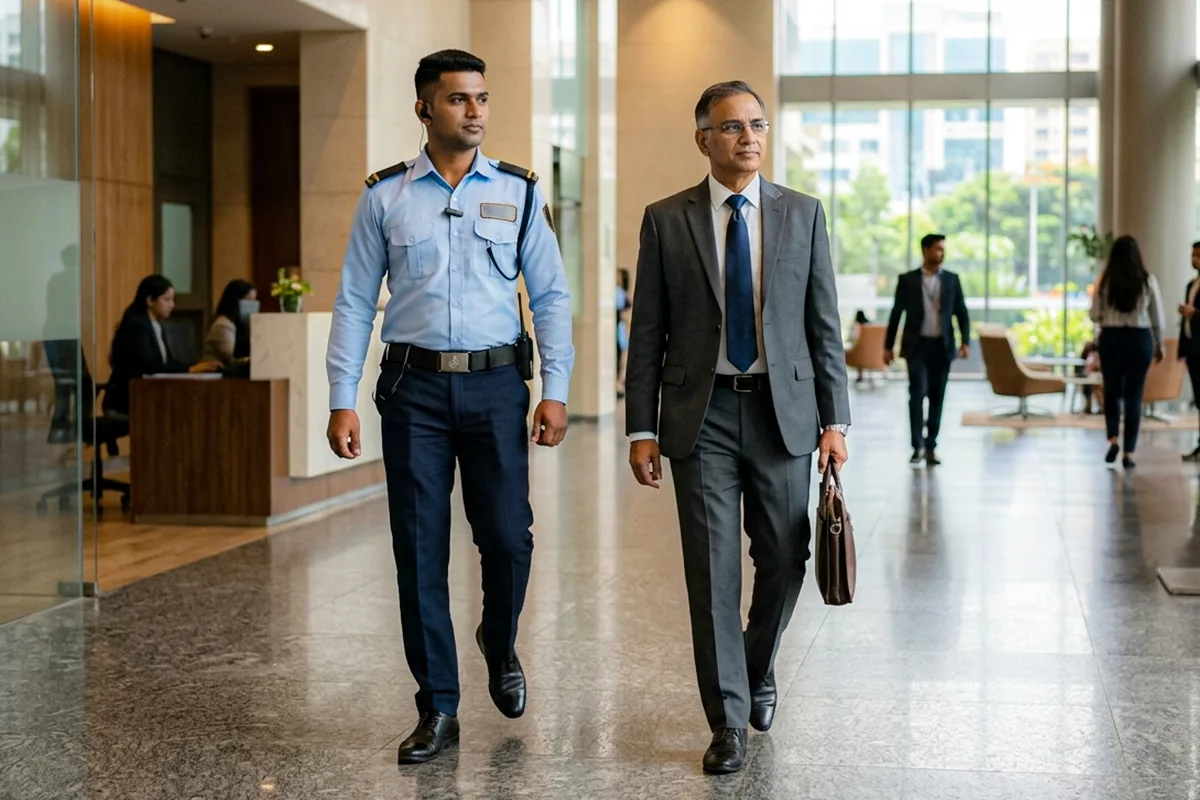
There’s a common assumption that executive protection is something reserved for film stars stepping out of a car surrounded by men in dark suits, or a politician being ushered through a crowd. In reality, the profile of a person who needs professional protection is far wider than that. A regional business head travelling to a new city for a plant inauguration, a startup founder who’s just gone public and started receiving unwanted attention, a family that’s inherited sudden wealth and public visibility. All of these are situations where executive protection quietly becomes relevant.
What determines the need isn’t fame in the traditional sense. It comes down to a mix of things: how visible someone is, how often they travel, what kind of risks their profession or public role exposes them to, and whether there’s a specific, identifiable threat involved. Because these factors differ so much from one individual to the next, professional executive security services are built around assessment first. The protection plan is shaped around the person, not the other way around.
This guide walks through who typically needs executive protection, why they seek it out, the situations where it matters most, and what it actually costs in India.
Table of Contents
ToggleCEOs and business executives are an obvious starting point. Anyone running a company of scale carries decision-making authority that affects hundreds or thousands of livelihoods. That alone can make them a target for disgruntled employees, aggressive competitors, or activists opposed to a business decision.
Corporate leaders and entrepreneurs, particularly those who are frequently in the media or actively building their public profile through conferences, interviews, and social platforms, often find that visibility invites a different kind of attention than the one they intended.
Celebrities and public figures deal with a fairly constant stream of fans, followers, and occasionally individuals whose interest crosses into obsession or harassment. Crowd management alone at public appearances is a specialised skill.
Politicians and government officials operate in an environment where security isn’t optional. Public office comes with exposure to political rivalry, protest movements, and in some cases organised threats.
High net worth individuals face risks tied directly to perceived wealth. Targeted theft, extortion attempts, and kidnapping for ransom scenarios are all real concerns, particularly when someone’s financial status is public knowledge.
Foreign executives and visiting dignitaries are often unfamiliar with local geography, traffic patterns, and risk zones. That unfamiliarity is exactly what makes coordinated protection during their stay a practical necessity rather than a luxury.
Individuals facing specific security threats could be anyone who has received threatening communication, is involved in a contentious legal matter, or has been publicly named in a dispute. What they have in common is a need for protection that responds to a known, defined risk.
Families requiring high level personal protection round out the list. Protection isn’t always about the principal individual alone. Spouses, children, and elderly family members are frequently included in a security plan, especially around school runs, travel, and public outings.
If you want a closer look at how this plays out for public figures specifically, our earlier piece on celebrity security guard services breaks down how professional teams manage crowd risk and public exposure day to day.
The reasons people actually pick up the phone and call a security agency tend to cluster around a few recurring themes.
Personal safety concerns: that have moved from vague unease to a genuine sense of vulnerability.
Public visibility: that’s grown faster than the individual is comfortable with. Business-related risks: including disputes, litigation, or decisions likely to provoke strong reactions.
Travel to unfamiliar locations: where local risks aren’t well understood by the traveller. Large public appearances: where crowd behaviour is unpredictable.
Threats, harassment, or unwanted attention: whether online or in person.
Protection of family members and associates: These may be softer targets than the principal individual.
In most cases, it isn’t one factor alone. It’s a combination that tips someone from “we should probably think about this” to actively hiring a protection team.
Certain moments carry disproportionately higher risk than day to day life, and this is usually where protection teams are deployed even by individuals who don’t need round the clock coverage.
Business travel: to cities or regions the individual doesn’t know well.
Public events and conferences: where the person is announced, seated visibly, or expected to interact with a large audience.
Corporate meetings: involving sensitive negotiations or high financial stakes.
High-profile events: such as product launches, award functions, or press briefings. International travel: where jurisdiction, language, and local threat patterns all change. Visits to unfamiliar locations: within India, including sites with limited security infrastructure.
Ongoing personal security requirements: where the risk isn’t tied to a single event but is a persistent part of the person’s life.
Our detailed breakdown of VIP protection duties and responsibilities covers exactly what a protection officer is doing behind the scenes during each of these scenarios, from route planning to venue sweeps.
This is one of the most common points of confusion, and it’s worth clarifying early because it directly affects both the service you should ask for and the price you should expect to pay.
A personal bodyguard is generally suited to more straightforward, lower risk requirements. Think accompanying someone through daily routines, providing a visible protective presence, and reacting to immediate physical threats.
Executive protection is a more layered service. It typically includes advance planning of routes and venues, risk assessment before travel or events, coordination with venue security and local authorities, secure transportation, and often a small team rather than a single individual. It’s built for situations where the risk is higher, more complex, or tied to a public role rather than just personal safety.
If you’re trying to work out which category your situation falls into, our comparison on executive protection vs personal bodyguard services goes through this decision in more detail.
Before approaching an agency, it helps to have clarity on a few things, because these directly shape the kind of team and plan you’ll be offered.
Level of public exposure, meaning how recognisable the individual is and in what circles. Potential security risks, and whether there’s a known threat or this is purely precautionary. Travel frequency, whether it’s occasional trips or a packed, constantly changing schedule. Nature of profession, since some roles carry inherent exposure such as media, politics, activism, or high finance. Event and public appearance requirements, or how often the person is in front of large or unscreened crowds. And the duration of protection required, whether that’s a single event, a short trip, or an ongoing arrangement.
Being upfront about these factors during the initial consultation is what allows an agency to build a plan that’s actually proportionate to the risk, rather than either under-securing or over-securing the situation.
There’s no single number here. Cost is shaped by several moving parts, and it’s worth understanding each one before you go shopping for quotes.
| What Drives the Cost | How It Affects Pricing |
| Duration of protection | A single-day event costs far less than a monthly retainer |
| Number of security professionals | A solo close protection officer costs less than a coordinated team |
| Location and travel requirements | Travel, lodging, and unfamiliar city logistics add to the total |
| Risk level | Precautionary coverage costs less than protection against a specific, known threat |
| Type of protection required | Event security, travel security, and full-time executive protection are priced differently |
As a general reference point in the Indian market, a single trained close protection officer typically starts from around ₹50,000 per month, with pricing moving upward depending on risk level and experience. Teams of two or more officers, secure transportation, and advance planning support push this higher, often into the ₹1,00,000 to ₹2,50,000+ per month range for comprehensive, high-risk coverage. Short-term engagements, such as a single event or a few days of travel security, are usually priced on a per-day basis rather than monthly, and can range from a few thousand rupees a day for basic coverage to significantly more for armed, high-risk, or international deployments.
For a more detailed breakdown by scenario, our guide on VIP protection services cost in India covers pricing across different levels of coverage.
Not every security provider is equipped to run executive protection well it’s a different discipline from static guarding. A few things worth checking before you commit:
If you’re evaluating options, it’s worth speaking directly with an established executive protection agency that can walk you through how they’d approach your specific situation, rather than quoting a flat package over the phone.
Securon builds executive protection around the individual, not a template. That includes:
As one of the professional security guard companies operating across South India, Securon works with business leaders, public figures, and families who need protection that’s discreet, well-trained, and genuinely responsive to their situation not just a visible presence.
There isn’t a fixed price or a fixed team size that applies to every client. The right starting point is always a proper risk assessment. If you’re weighing up whether you need occasional event coverage, ongoing personal protection, or a full executive protection team, it’s worth having that conversation with a provider who can actually assess your situation rather than sell you a package.
Business leaders, public figures, politicians, high net worth individuals, foreign executives, and anyone facing a specific security threat or high public visibility can benefit from executive protection. Families connected to these individuals are often included as well.
Many do, particularly those in high-stakes industries, those involved in contentious business decisions, or those with a significant public profile. The need typically grows with visibility and travel frequency.
Yes. Crowd management, public appearance planning, and protection from unwanted attention are common requirements for celebrities and other public figures.
A bodyguard usually provides direct physical protection for lower-risk, day-to-day situations. Executive protection is broader, including advance planning, risk assessment, coordinated teams, and secure transportation, and is generally suited to higher-risk or more complex requirements.
Costs typically start from around ₹50,000 per month for a single trained close protection officer, rising to ₹1,00,000 to ₹2,50,000+ per month for a full team with travel and event coverage. Short-term or event-based protection is usually priced per day instead.
Yes. Travel security is one of the more common requests, covering route planning, secure transportation, and coordination in unfamiliar cities or countries.
Start with a risk assessment conversation with a professional security agency in Bangalore that has direct experience with executive and VIP protection, rather than only static guarding.